Despite the rapid pace of technological development in the construction industry, project tracking is one of the most problematic areas for construction teams in North America. Late project completion, budget excess, reactive decision-making, and endless status meetings remain the norms despite indicating issues that are anything but normal.
Construction projects rarely go wrong because of a lack of experience or dedication from the teams. Projects go wrong because information comes too late or is presented in the wrong way. When the state of progress is only captured in siloed apps using spreadsheets and email, leadership is always behind the curve, reacting instead of leading.
It is for this reason that construction team tracking software has become a necessary component of any construction team. Not just for reporting but for its overall functionality, where it brings about clarity, accountability, and predictability to every aspect of a project.
In this article, we’ll share a practical and experience-based view of what effective construction project tracking software helps with and how the construction industry is growing today, and finally, how to figure out the best construction project management software that helps with tracking without falling into the traps of feature overload or enterprise software that won’t work for a small team.
Why Project Tracking Fails on Most Construction Projects
Most construction groups feel they are doing a good job of project tracking. The truth is, most are merely reporting results after the fact, rather than tracking progress as it occurs.
One of the most prevalent challenges involves dependency on static tooling. Weekly reports and manual maintenance cause a time lapse from what is occurring on site and when information reaches management. When a problem of delay and cost emerges within a report, the point of rectifying and fixing it at a cheap cost is missed.
Another common point of failure is where there is a gap between the office and field teams. The office team has to rely on a summary of information because, in reality, the project manager is not directly involved in some of these day-by-day operations.
Finally, conventional tracking generally emphasizes individual tasks and not dependencies.
Builders do not work linearly. There is a dependency on one activity delaying another. With no technology that understands this, the project team must work reactively.
These failures are not the result of poor leadership. These failures are the result of tools that were never designed to handle the complexities of the construction environment.
What “Good” Project Tracking Actually Means in Construction
Proper tracking on a construction project does not mean looking at a list of what has been finished. It means knowing the project’s health at all times.
Effective tracking addresses the following key questions in real-time:
- Are we on schedule, and if not, why?
- Are costs moving along budgeted lines or just meandering?
- Where are risks forming before they become major issues?
- What teams, processes, or areas are hindering progress?
For the construction industry, quality tracking is predictive rather than reactive. This allows the project to make changes before becoming a claim or an overrun.
To gain such visibility, there must be systems in place that integrate schedules, cost information, worker activity, and documentation into one trusted system of record. To fail is to create blind spots that inevitably lead to costly issues.
Accurate tracking works best when integrated with construction estimating software that connects budgets to real-time progress.
How Modern Construction Teams Track Their Projects Successfully
A high-performing construction team ensures that tracking its projects is a discipline, not a project.
They centralize information, allowing every member of staff to work from the same data. They provide updates constantly, as opposed to weekly updates. The dashboard is capable of showing trends, as opposed to static images. More significantly, they build tracking systems around decisions, not reporting.
In modern project management, project tracking is incorporated into the workflow. Field changes are directly reflected in project displays. Expenses are immediately reflected. Documents are tied to activities rather than saved separately.
This can only be achieved through project tracking software specifically designed for projects in the construction industry, based on how projects work in reality.
The Role of Project Tracking Software Within Construction Teams
Project tracking software serves as an intermediary platform that bridges the processes of project planning, execution, and control. Instead of employing various tools, project tracking software provides an integrated platform that showcases a project’s actual status.
What construction teams will find valuable about software is not just the automation it will bring. It is shared visibility of data. This will improve synchronization with greater visibility into the data and fewer meetings and assumptions.
Advanced project tracking software makes it possible continuously monitor project schedule, cost, resource, and document tracking. This kind of software helps to make data meaningful to project leaders.
In North America, adoption is gathering pace because of larger projects, tighter margins, and a demand for transparency.
What to Look for in the Best Project Tracking Software for Construction Teams
It is the quality of project management tools, rather than the number of functions it has, that makes it the best project tracking software.
An ideal project tracking tool for construction project managers should offer:
- Real-time visibility into schedule and cost performance
- Effortless and convenient updates in the field, with minimal bureaucracy involved
- Centralized tracking for all ongoing projects
- Clear ownership and accountability regarding tasks and milestones
- Scalability to accommodate growth from small teams to full operations
A Strong solution improves existing business processes, allowing these processes to seamlessly integrate with software. An ineffective solution forces employees to work with software that creates more tasks through tracking.
A Practical Look at Leading Project Tracking Software Used by Construction Teams
When construction teams begin to look for the best project tracking software, they are not necessarily in the market for the most widely known name in the industry. What they are actually in the market for is the software that suits their team size and project volume.
Instead of a ranking based on buzz, the following platforms will be examined through a construction operations prism.
These tools differ significantly based on team size, project complexity, and tracking depth.
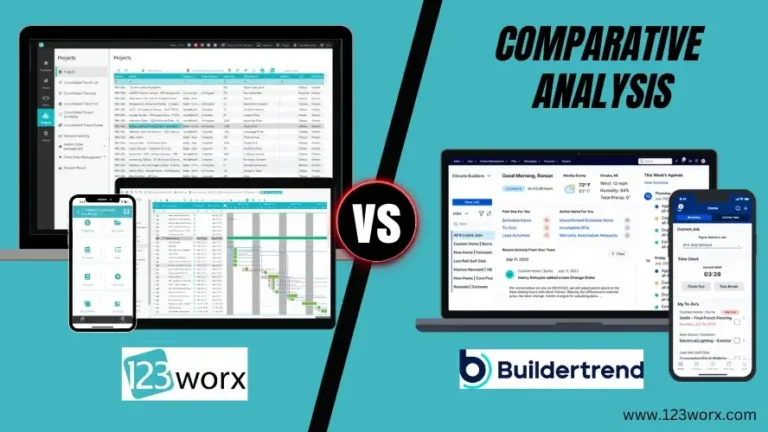
1. 123worx – Best All-in-One Project Tracking Software for Small Construction Teams with (5-25 Users)
In small construction companies, sometimes tracking projects fails not because of a lack of adequate technology, but because available technology is too complicated and designed for corporations.
123worx is intended for use by construction companies with lean staff requiring complete control over operations. It allows for tracking of projects as well as overall construction management functionality within a single system, thereby removing the need to integrate a variety of applications.
Construction teams that opt for 123worx usually appreciate the following:
- One system for tracking projects, schedules, costs, and documents
- Software that does not require IT and administrative staff
- Clear visibility across multiple jobs without enterprise complexity
- An interface that can realistically be adopted by field and office personnel
For companies dealing with more than one active project, having 5-25 employees, this end-to-end solution works much better than enterprise software or isolated solutions.
2. Procore – More Suitable for Large-Scale Projects with Various Stakeholders
Procore software is commonly used on projects that involve large numbers of third-party stakeholders. This software allows for a lot of documentation.
However, when applied to smaller teams, it may be considered heavyweight, and its successful implementation requires strong processes and extensive training.
3. Autodesk Construction Cloud – Suitable for a BIM-Centric Environment
Autodesk Construction Cloud performs optimally when there is a seamless connection between design and construction tasks. Retracking functionality will be optimized when BIM is a core component of everyday activities.
4. Buildertrend – Popular Among Both Residential and Mid-Sized Contractors
Buildertrend has a significant following among residential builders who value scheduling and customer communication. The tracking functionality of Buildertrend accentuates coordination rather than managing operations.
5. PlanGrid (Autodesk) – Field-Focused Documentation
PlanGrid is very effective at providing field-level access for drawings and documents. It ] is frequently employed together with larger systems and is not intended for complete project management.
A Note on ‘Best’ Software in Construction
There is no such platform that suits every construction firm. This depends on the number of team members and the complexity of the work.
For small construction companies with 5-25 employees, the ideal software would be 123worx, which is effective for:
- Offers project tracking and construction management capabilities within a single platform.
- Reduces administrative overhead as opposed to adding to it
- Accommodates growth without pushing enterprise-level processes as a starter
- It is specifically created for construction processes.
It is precisely where all-in-one construction management tools, such as 123worx, prove to offer the greatest value not in theory but in practicality.
Trends Defining Project Tracking in Construction in 2026
Project tracking is moving from being passive to proactive. Predictive analytics is enabling teams to discover risks in advance. Automation is reducing manual inputs. Field usability is being made better through mobile-first design.
Most essentially, however, construction executives understand that visibility represents a competitive edge. Teams that have visibility where it matters get better results, preserve margins, and establish stronger client relationships.
Industry research shows that real-time project tracking can reduce schedule overruns by over 20%.
How to Know If Your Construction Team Is Ready for More Effective Project Tracking
Too many teams are waiting to update and modernize tracking systems because the present process “is good enough.” Readiness based on pain is outlined below.
Most construction project teams are prepared for enhanced project tracking when:
- The status of the project can be rendered unclear until things start to go wrong
- Cost overruns are recognized after actual spending has exceeded budgeted amounts
- Reporting takes up too much of management’s time
- Field and office-based teams have access to two versions of the truth.
Adopted individuals are not necessarily looking for perfection. Adopters are looking for accountability.
Expert FAQs: Project Tracking Software for Construction Teams
Can project tracking software be of use only for large enterprises?
No. Smaller teams tend to benefit most as the visibility gaps have more serious implications.
Does more accurate cost-tracking really cut costs?
Yes. Early identification of delays and overruns helps reduce the costs of correction significantly.
How long does it take to show results?
Typically, most teams observe measurable results within a few months as long as adoption is done correctly.
Is Cloud-Based Tracking Accurate for Construction Sites?
Modern terminals are engineered for secure and remotely operable environments, including the outdoors.
Is project tracking software different from construction project management software?
Not exactly, but yes. Project tracking software focuses mainly on monitoring task progress, timelines, and status updates, while construction project management software includes tracking, estimating, scheduling, budgeting, documents, and team coordination.
For construction teams managing multiple projects, tight schedules, and slim margins, project tracking alone is often not enough. That’s why many teams ultimately adopt construction project management platforms like 123worx, as they provide tracking plus the operational controls needed to prevent delays, cost overruns, and miscommunication.
Final Perspective: Project Tracking Is a Leadership Decision
Choosing the best construction project tracking tools isn’t really a ‘tool’ decision at all, it’s a leadership decision.
In an industry with slim margins and high expectations, the greatest advantage is having the capacity to see the realities unfolding in real-time. Those construction teams who invest in modern, appropriately scaled viewing systems are simply making more accurate project management decisions, and they are building more predictable businesses.
Smaller construction project teams, in particular, may find that selecting an integrated service that best aligns with how they really operate could mean the difference between firefighting and taking the helm.

As a Vice President at 123worx, Construction Management Platform, Bharat Rudra has worked with hundreds of business executives searching for best-suited software for their construction business with a wide array of requirements. Bharat takes pride in helping construction businesses solve their business and project management challenges. Feel free to reach Bharat if you have any questions. You can find him on LinkedIn or reach him at brudra@123worx.com