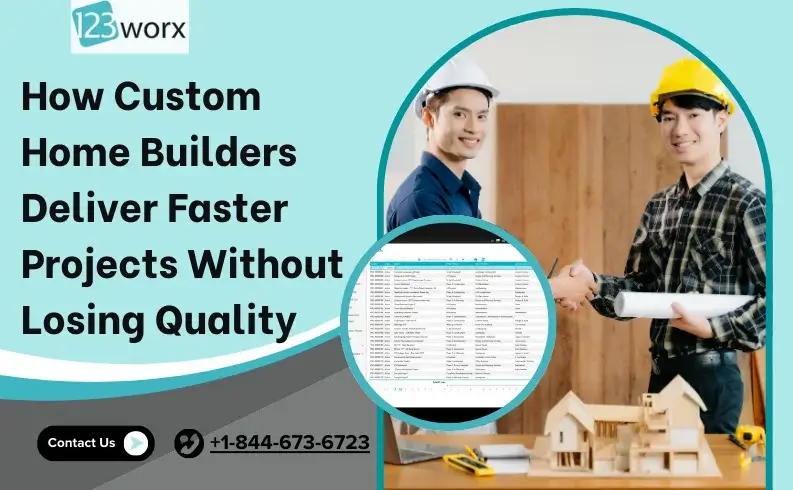
In custom home construction, speed and quality are often seen as opposing goals.
Many in the construction industry believe that accelerating the pace leads to mistakes, rework, and lower quality. Conversely, homeowners are seeking faster completion times, clearer schedules, and fewer unexpected problems. This situation has given rise to a common industry saying: it’s a choice between speed and good work, as having both isn’t feasible.
The truth is that the most successful custom homebuilders in today’s market prove this assumption false every day.
The goal of completing projects quickly with no loss of quality is in no way an emphasis on rushing through things and cutting corners. Rather, it is removing inefficiencies and making it easier to coordinate by creating systems that will allow trade workers to work at their highest levels of competence.
This blog explains how custom home builders can reduce construction time without compromising quality and, in many cases, improve it.
Why Custom Home Projects Often Exceed Their Timelines?
Before we look at solutions, it is a good idea to examine where time is being spent in custom home-building projects.
Delays are seldom due to the actual construction. It can be traced to the following factors:
- Unclear decisions
- Late information
- Poor coordination between trades
- Rework due to miscommunication
- Awaiting approvals or materials
- Reactive problem-solving
Delays mostly occur due to process issues rather than issues related to work performance.
Builders who want to move faster should focus less on working harder and more on eliminating friction in the process.
The Hidden Relationship Between Speed and Quality
Indeed, one of the biggest myths in the construction industry regards the notion that speed diminishes the standard of work.
Actually, poor quality is usually the result of rushing in disorganized environments rather than inefficient performance in well-organized environments.
When teams:
- Know exactly what they are building
- Work in predictable sequences
- Are not forced to redo work
- Quality improves automatically.
The point is not to compress time at random, but to decrease confusion and rework. By reducing confusion, contractors spend less time fixing mistakes and more time delivering quality.
Start With Better Pre-Construction Planning
The projects that end quickly usually begin better.
Custom home builders who spend more time on pre-construction planning are less likely to encounter delays in the future. It is considered a predictor of project performance due to discipline in planning.
This involves:
- Well-defined scopes before the onset of excavation activities
- Early coordination of important trades
- Realistic ordering of work
- Clear material specifications
- Identification of the long-lead items
Going forward too quickly without solving certain issues leads to bottlenecks, which cost significantly more down the line.
Pre-construction is not overhead; it is actually time insurance.
Reduce Decision Bottlenecks with Early Client Alignment
Custom homes require far more decision-making by clients than almost any other type of construction. Interior and exterior finishes, floor plans, fixtures, and systems all need to be approved.
Delays result from making decisions “just in time” rather than “just early enough.”
Contractors with quick completion times:
- Lead clients in a decision-making process that involves logical stages
- Determining deadlines for making selections
- Describe how late decisions influence timelines.
- Document approvals
This eliminates the wait on trades and avoids costly resequencing.
People do not object to structure; people object to surprises.
Enhance Trade Coordination Instead of Forcing Schedules
Often, construction companies shorten project timelines to accelerate the construction process. In most cases, this often backfires.
Schedules fail if trades are:
- Unaware of upstream delays
- Use of old drawings
- Being forced to mobilize repeatedly
- Waiting on unfinished work
The fastest projects have smooth handoffs between trades.
Builders may also benefit from:
- Identification of readiness criteria for each trade
- Communicating the changes immediately
- Prevention of over-stacking in trades in constricted areas
- Making sure prerequisites are met before work begins
As far as trades are concerned, if they believe that the use of a construction scheduling tool will improve scheduling and productivity.
Prevent Rework with Good Documentation
One of the biggest unseen killers of velocity and quality is rework.
It happens when:
- Teams begin work using outdated drawings
- Verbal communications contradict written plans
- Alterations are not disseminated uniformly
- Assumptions replace confirmations
Each case of rework takes time, effort, and goodwill.
The builders who complete projects quickly are those who invest in well-documented information. These builders make sure that:
- One source of truth for plans and revisions
- Ease of access to up-to-date information on the site
- Written confirmation of changes
- Drawings and photos for visual clarity
If things are clear, there are fewer mistakes made. Fewer mistakes mean faster delivery and higher quality.
Standardize What Should Not Be Custom
Custom home building is not about reinventing a process.
Many of the top builders gain speed through standardization in areas that are non-client-facing, for example:
- Internal workflows
- Trade sequences
- Quality checklists
- Communication formats
- Documentation practices
Standardization leads to predictability. Predictability leads to fewer delays.
In this way, by leaving the value of customization to the designs and materials, rather than to the structure itself, the value of quality is preserved, and efficiency is improved.
Managing Complexity by Means of Systems Rather Than Memory
As the project becomes more complex, it becomes risky to depend on memory.
Contractors performing projects more quickly than their competitors rely on processes, not memory. These processes include:
- Schedules
- Documents
- Changes
- Communication
- Accountability
This more structured approach to project management for custom home builders is easier to maintain with construction management software like 123worx.
When information is visible and structured, it results in faster decision-making, and that happens with fewer errors.
Build Quality into the Process, Not Just the Final Inspection
Quality cannot be inspected into a project at the end. It has to be embedded throughout the project.
Fast, high-quality builders:
- Define quality expectations clearly
- Hold staged inspections instead of final catch-ups
- Tackle problems before finishing a task
- Promoting trades to identify issues preemptively
Early quality control can prevent “cascading” problems that could hinder projects in the end.
The builders who concentrate on delivering quality all along end up completing projects ahead of those who have to go back and correct things.
Improve Communication Without Increasing Noise
More communication is certainly not always better communication.
Those builders who work faster communicate on purpose and do not do it all the time.
They follow
- Similar update formats
- Prioritize and distinguish between pressing topics and regular updates
- Document decisions clearly
- Prevent dispersed messages on platforms
Effective communication prevents misunderstandings and unnecessary follow-ups. This enables teams to concentrate on building and not on clarification.
Leverage Technology to Reduce Administrative Drag
Administrative work quietly hinders the progress of projects.
Manual reporting, duplicated data entry, and hunting down the latest updates all consume time that could be directed towards solving problems that matter.
Constructors who use the latest technology cut administration drag because:
- Automated reporting
- Information centralization
- Enhanced visibility for all stakeholders
- Reducing manual coordination
This does not replace human intelligence but enhances it.
Such platforms, like 123Worx, make it possible for the builders to retain control and still be able to move faster without losing standards.
Why Faster Projects Often Deliver Better Client Satisfaction?
Speed is not just an internal advantage. It also impacts the client experience.
Faster projects:
- Manage client stress
- Keep disruption to daily life to a minimum
- Establish confidence in the builder
- Enhance referral potential
When speed comes from better organization rather than shortcuts, clients experience the process as professional and well-managed.
It enhances reputation and long-term growth.
Common Mistakes Builders Make When Trying to Move Faster
Many construction companies’ slow projects down by:
- Over-compression of schedules
- Missing planning steps
- Mandating trades to rush
- Frequently making late changes
- Using unofficial communication channels
Such strategies create short-term momentum and long-term delay.
The best speed is achieved through discipline and focus, not by being under pressure.
The Long-Term Benefit of Building Faster with Sound Quality
The custom home builders that successfully balance these areas will gain a strong competitive advantage. They:
- Take on more projects on an annual basis
- Protect margins
- Minimize stress on teams
- Establish stronger relationships with clients
- Enhance their brand reputation
Indeed, in a marketplace in which homeowners demand swift performance and perfection, the availability of such a capability has the potential to serve as a defining differentiator.
Final Thoughts: Speed Is a Result of Better Systems, Not Faster Labor
Speed no longer has to come at the expense of quality. The key to fast building of custom homes today is the result of improved planning, communication, systems, and execution.
Those builders who concentrate on reducing friction are better at building quicker and better than those who try to push harder.
This is how successful custom home builders compete in today’s market.

As a Vice President at 123worx, Construction Management Platform, Bharat Rudra has worked with hundreds of business executives searching for best-suited software for their construction business with a wide array of requirements. Bharat takes pride in helping construction businesses solve their business and project management challenges. Feel free to reach Bharat if you have any questions. You can find him on LinkedIn or reach him at brudra@123worx.com