All construction companies would like to have a “great team,” but few can actually define what that actually means.
Are great teams faster?
More accurate? More communicative? And more profitable?
The truth is, a great construction team does not possess one characteristic. It is consistent under pressure.
In 2026, the construction community works under conditions where there are continuous restrictions. The workforce is short. The projects are sophisticated. The customers are demanding in terms of transparency. The margins are thin. This is an industry where talent by itself is inadequate. Performance is contingent upon the interplay between people, processes, and tools.
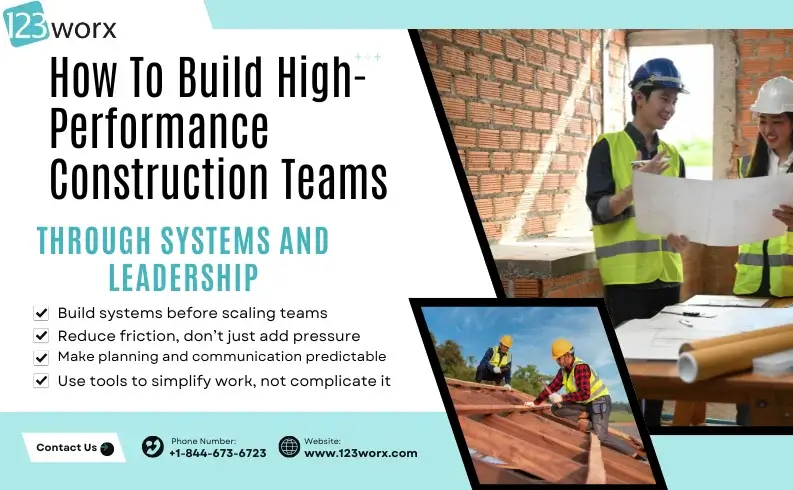
It’s not the case that successful construction teams are assembled by hiring some bright minds in construction technology and seeing how things work out. Rather, successful construction teams need to be created on purpose through deliberate process, communication, technology, and leadership.
In this article, we’ll explain that construction companies should form high-performance teams that produce high-quality work on a predictable basis without burning out, creating chaos, and constantly fighting fires.
What “High Performance” Actually Means in Construction?
Performance in construction work is frequently misconceived. It has nothing to do with putting in long hours or completing work quickly. On the contrary, such practices reflect poor performance disguised as urgency.
A high-performance construction team always provides:
- Projects with good adherence to schedules
- Work that meets quality standards with little rework
- Effective communication between the field operations and the office
- Predictable outcomes for several projects
- Maintaining a strong level of morale even under pressure
The critical word here is “consistency”. Any person can deliver well on a project. Excellent teams perform well despite tough circumstances.
It is only possible to get that level of performance if it is a system that supports people and not one that makes people work around a faulty system.
Why Most Construction Teams Underperform (Even with Good People)
One of the most difficult things for construction managers to realize is that most of the issues they encounter regarding team performance are not personnel issues; they are process-related issues.
So, when the foremen receive data that is either late or partially received, they face difficulties.
On the other hand, when the project managers keep following up for updates all the time, they get exhausted. In addition to that, when the office staff members experience burnout, they lack clarity regarding the flow, or are constantly changing.
Underperformance normally results from:
- Lack of clear expectations
- Fragmented communication
- Lack of standardized processes
- Reactive decision-making
- Lack of work status visibility
However, when such issues continue to arise, even the best-performing teams can become frustrated and inconsistent. Highly performing teams can be built by reducing friction rather than attempting to work harder.
Leadership Sets the Ceiling for Team Performance
Construction crews rarely exceed their leadership structures.
Leaders’ impact occurs not only through their decisions but through what they tolerate. As a result of ambiguous scope, late decisions, or unofficial communications being tolerated, the response from the teams is to adjust to it, which is not always very efficient.
High-performing construction leaders:
- Set Expectations
- Prioritize planning over urgency
- Promote early problem identification
- Focus on systems, instead of blame
Leaders don’t focus on managing details. Instead, it’s all about designing a context in which teams are able to function with minimal external interference.
Clear Roles and Responsibilities Reduce Friction Immediately
A clearly defined set of roles and responsibilities will remove friction right away. A lack of understanding about who is responsible is one of the quickest ways to bring a construction crew to a standstill.
If the ownership of decisions, issues, and tasks is not clear to other members of a team, the work process gets halted. People just wait and wait.
High-performing teams function with:
- Clearly defined roles
- Understanding authority boundaries
- Known escalation paths
This makes decisions happen faster because there are not as many meetings, phone calls, or emails involved. Perhaps most significantly, role clarity enhances accountability without allowing micromanaging.
If all parties are aware of their own “lane,” it is easier to achieve.
The Role of Standardized Processes in Achieving Excellence
Standardization may have a bad name in the construction industry, especially in custom construction. But standardization is not rigidization. It means consistency in matters of consistency.
High-performing teams standardize:
- How projects are planned
- How information is shared
- Your changes are handled in what way
- How quality is checked
This helps to remove variability, and variability is the enemy of performance. When variability is reduced, teams spend fewer cycles getting things done and actually doing the work.
Standard work enables teams to focus on “craftsmanship,” not “coordination chaos,” when construction workflows are managed in a single system
Planning Discipline Separates Average Teams from Elite Ones
Planning is perhaps the least appreciated factor that influences construction performance. Often, teams dive into the execution phase with limited information, planning to sort it out later down the line.
High-performance teams put more effort into the following areas:
- Scope clarity
- The order of the sequencing should
- Defining Dependencies
- Confirming readiness before embarking on tasks.
This is exactly why a good scheduling system for remodelers and contractors matters so much in construction.
This doesn’t slow down the projects. Instead, it increases the speed of the projects by minimizing disruptions in the latter stage. It is considered a predictor of project performance due to discipline in planning.
Communication Structure Matters More Than Communication Volume
Construction teams are constantly communicating, although communication can be misinterpreted.
It’s not communication that’s the problem. It’s the lack of structure.
High-performing teams employ:
- Anonymously provided feedback
- Standard update formats
- Transparent record-keeping regarding decision-making
It helps to avoid confusion, and it ensures the information is not lost. The teams know where to find the answer to their questions, rather than depending on memory recall.
Organized communication converts noise into a signal.
Trust is Established through Predictability, Not Motivation
Motivation is important, but predictability is key to trust, and trust is critical in achieving high performance.
When each member of the team feels that he or she can
- Accurate Schedules
- Detailed instructions
- Timely decisions
- Consistent leadership behavior
Rather, they work with confidence instead of caution. This is because confidence leads to fewer mistakes, quicker execution of work, and higher morale.
Great construction teams aren’t necessarily bonded through speeches and reward systems. They are actually bonded through working systems.
Field and Office Alignment Is Non-Negotiable
One of the largest performance gaps in the construction industry is between those who work in the field and those who work in the office.
Without input from office teams, office schedules fail. Rework increases when field teams do not have updated information. High-performance teams bridge these divides on purpose. According to industry research, miscommunication and lack of standardized processes are among the top causes of rework in construction projects.
They harmonize in the following aspects:
- Real-time visibility into projects
- Standardizing reporting
- Involving field leadership in planning
It helps in minimizing the ‘us vs. them’ phenomenon and leads to collective responsibility for the outcomes.
Tools Should Support Teams, Not Burden Them
Technology can be the catalyst for high performance, while it can also be the destroyer of it.
Too many tools, poorly designed systems, or disjointed platforms hinder performance and increase mental workload. Successful construction teams rely on tools that make processes easier, not harder.
Modern construction platforms, such as 123worx, assist the team in functioning effectively by allowing the schedules, documents, communication, and cost information of the team to be centralized in the system.
Tools will not replace experience; they will protect experience against overload.
Training is About Consistency, Not Just Skill
The type of training in the construction industry is usually technical in nature. Although this is important, it misses another critical component of performance, which is process training.
High-performance teams receive training in:
- How the corporation implements projects
- How information flows
- Decisions are made in which way
- How matters are escalated
This allows new staff to be integrated easily and experienced staff members to work consistently. Training ensures that expertise is not rooted in tacit knowledge.
Accountability Without Blame Drives Sustainable Performance
Accountability is critical, but responsibility undermines performance.
High-performing teams operate in terms of “process and outcomes, not personality.” When there is clarity on what is expected, it is easier to hold someone accountable.
This creates a culture in which problems are tackled at the earliest and in a constructive manner, rather than being swept under the carpet until they escalate into crises. It makes the employees feel safe to bring up their worries to others on the team, which has many positive effects on performance.
Measuring What Matters Reinforces High Performance
What gets measured, changes.
High-performing construction team’s track:
- Reliability of the schedule
- Rework levels
- Decision time taken
- Productivity trends
These factors help not to penalize, but to optimize. When teams look back on how they impact certain outcomes, performance turns from reactive to intentional.
High Performance Teams Decrease Burnout, Not Increase It
Historically, in construction, there has been an industry myth claiming that higher performance is always attained under conditions involving constant pressure.
In fact, the reverse is true. High-performing teams experience:
- Less chaos
- Fewer emergencies.
- More predictable workloads
- Higher job satisfaction
Burnout is more systems’ problems than an employee’s effort. When tasks are simple, and systems enable the act, teams can function at an exceptionally high level without burning out.
Scaling Without Losing Performance Requires Systems
This is where purpose-built construction systems make the difference. The problem with many construction businesses is that they succeed at a small scale but can’t continue to perform well as size increases.
Large-scale performance demands that:
- Documented processes
- Effective communication systems
- Consistent tools
- Leadership discipline
By their absence, growth amplifies problems, rather than success. Successful organizations establish systems early, so success does not depend on some exceptional individuals.
Culture is a Result of Systems, Not Slogans
A construction culture is a subject that is usually explained in the abstract, yet the reality is that the culture is shaped through actual practices in the work environment every day.
If systems are clear, communications are respectful, and decision-making occurs promptly, culture will improve in and of itself when these things are in place. When there is chaos and confusion, no amount of motivational messaging will improve it.
High-performance culture is designed, not declared.
Concluding Thoughts: The Key to High Performance is Removing Friction
Indeed, the first thing that one should remember when it comes to making a high-performance construction team is that friction is something that must be eliminated if one wishes for better performance.
Having good processes, good tools, effective communication, and disciplined leadership enables individuals to perform at their best without stress.
It won’t be the toughest or loudest construction firms that come out on top in 2026 and beyond. Instead, it would be those who develop a system to ensure that their teams perform at a high level.

As a Vice President at 123worx, Construction Management Platform, Bharat Rudra has worked with hundreds of business executives searching for best-suited software for their construction business with a wide array of requirements. Bharat takes pride in helping construction businesses solve their business and project management challenges. Feel free to reach Bharat if you have any questions. You can find him on LinkedIn or reach him at brudra@123worx.com