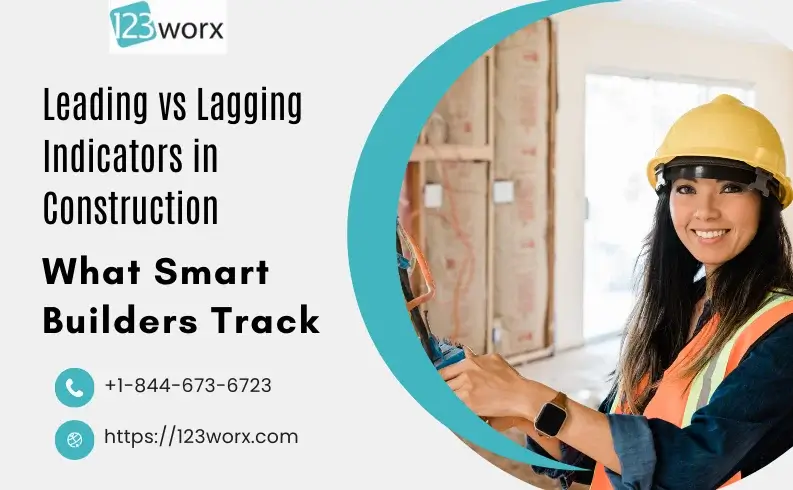
How smart builders use project indicators to stay ahead of delays, cost overruns, and project risks.
Custom home building is a business of constant decisions made in an uncertain environment. Each project is different, each project is full of unknowns, each client’s expectations are changing, and each project schedule is influenced by weather, suppliers, inspections, and human coordination.
In this world, the line between a profitable and successful project and a stressful and over-budget project is rarely the builder’s craftsmanship, but rather their ability to see and control the project.
The most successful custom home builders operate differently. They don’t just measure what happened, they measure what’s about to happen.
This is where the distinction between leading and lagging indicators becomes one of the most powerful tools in modern construction project management.
In this article, we will explain:
- What are leading and lagging indicators in construction?
- Why do custom home builders need both lagging and leading indicators?
- What are the most important lagging and leading indicators for custom home builders?
- How do they impact the project’s schedule, budget, quality, and client satisfaction?
- How do you create an indicator system that actually improves your project’s performance?
- And finally, how do modern construction project management tools like 123worx make this all work in the real world?
If you want to move from a reactive project management approach to a proactive approach, this is one of the most important concepts you can learn.
To understand this shift from reactive to proactive management, builders need to understand how performance indicators work.
Understanding Performance Indicators in Construction
In simple terms, performance indicators are signals that tell you how your project or business is performing.
In construction, these can include:
- Schedule Performance
- Cost Performance
- Quality
- Safety
- Productivity
- Client Satisfaction
- Cash Flow
- Risk Exposure
However, not all of these metrics tell you the same thing.
Some tell you what has happened. Others tell you what is going to happen.
This is important.
Construction businesses that focus on what has happened are always looking in the rear-view mirror.
Construction businesses that focus only on what has already happened are always looking in the rear-view mirror.
This is where lagging and leading indicators come into play.
What Are Lagging Indicators in Construction Projects?
Lagging indicators are those used to measure results after something has happened. These indicators tell you what has happened. Lagging indicators are backward-looking.
In custom home construction, lagging indicators can include:
- Final Project Profit/Loss
- Schedule Overrun (Days Late or Early)
- Final Cost vs. Original Budget
- Number of Defects at Closeout
- Number of Change Orders at Closeout
- Client Satisfaction Score after handover
- Safety Incidents Recorded Last Month
- Warranty Claims at Project Closeout
All of these indicators are important because they reveal how a project ultimately performed.
However, there is a problem with these. You cannot change them anymore.
If you find at the end of your project that your margin is gone, then great. That is useful information for your next project. But it does not save your current project.
Lagging indicators are similar to a medical autopsy. They reveal what went wrong, but they don’t help the patient avoid the illness in the first place.
What Are Leading Indicators in Custom Home Construction?
Leading indicators are measures of activity, conditions, and trends that forecast outcomes or events that will happen in the future. They are forward-looking and often function as an alarm or early warning system.
Some of the leading indicators that could be applicable in home construction may include:
- Percentage of tasks completed within the scheduled time this week
- Number of tasks or decisions still pending
- Schedule float consumed
- Variance between intended and actual productivity
- Number of quality problems still pending
- Subcontractor manpower shortages
- Delays in receiving materials
- Turnaround time
- Number of change order requests
- Number of failed inspections
These metrics do not inform you of your outcome; they inform you of your direction or trend towards your outcome. If your percentage of tasks completed is going down, your schedule is in trouble.
Many of these issues originate from early planning errors, which is why builders often review common project planning mistakes for home builders when improving project controls.
If the number of tasks or decisions still pending is going up, your productivity is going down. If your number of change order requests is going up, your budget risk is going up.
Leading indicators offer the advantage of timely intervention, allowing for course correction.
Why Builders Need Both Leading and Lagging Indicators
Some homebuilders may tend to focus more on lagging indicators because they may be more easily measured and understood, such as profit, variance, cost overrun, and client satisfaction, which occur at the very end of projects.
Some homebuilders may get excited by data and begin tracking dozens of leading indicators, but they do not link them to business outcomes.
However, the truth is that you really do need both:
- Lagging indicators show whether your strategy worked, while Leading indicators reveal whether your project is drifting off course
- Lagging indicators support accountability and learning, while Leading indicators enable control and prevention
In home construction projects, which tend to be long and very high-risk, waiting until the very end of projects to see if your strategy worked is not an effective strategy.
The Problem with Managing by Lagging Indicators Alone
Some common lagging indicators that project managers encounter include:
- You discover that labor costs are 20% higher than budgeted at month-end.
- You discover that projects are running behind schedule at the end of the quarter.
- You discover that change orders killed the profit at closeout.
- You discover that client satisfaction is low at project closeout.
In each of these cases, the project manager discovers that there is a problem, but the damage is done.
In each case, there is little that can be done except:
- Work overtime
- Cut corners (not a good idea!)
- Absorbing the loss
- Blame the client
- Hope that the next project will go better
This is a reactive management style. It is stressful, unpredictable, and difficult to scale.
Project managers who manage solely with lagging indicators feel:
- Busy, but not in control
- Profitable, but not reliable
- Stressed, always
- Dependent on “heroic” efforts from their team
How Leading Indicators Change Project Outcomes
Imagine a project manager who discovers that:
- Task completion rate is dropping from 95% to 80% over two weeks
- RFIs are doubling each month
- Inspection failures are rising
- Subcontractor manpower reports indicate a shortage next month
- Material lead times are beginning to slip
- Change requests are rising during the framing phase
None of these signals is a disaster individually. However, together they indicate a developing problem:
This project is headed for delay and cost overrun unless we do something about it.
With leading indicators, the project manager can take action:
- Add resources
- Re-sequence tasks
- Push tasks
- Escalate approvals
- Re-negotiate delivery dates
- Re-plan Critical Path Activities
This is proactive management. This is how top-performing builders protect their profits and reputation.
Lagging Indicators Every Custom Home Builder Should Track
Let’s examine the lagging indicators that help builders evaluate the final performance of their projects.
1. Final Project Profit Margin
This is the final business result. This indicator shows whether your pricing strategy, estimating accuracy, project execution, and change management were effective.
But you won’t see this until after you’re done.
This is important for:
- Evaluating your estimate
- Reviewing your types of projects
- Analyzing your subcontractors
- Improving your bids
But this is not going to help you save your current project. However, this is extremely important for your future projects.
2. Schedule Variance (Days Early or Late)
This is an important lagging indicator of your project management skills and your original project plan.
This is important for:
- Identifying problems in your plan
- Evaluating your scheduling assumptions
- Identifying areas of your projects that tend to be late
- Improving your project plan
Again, you won’t see this until after you’re done, but this is extremely valuable.
3. Cost Variance (Budget vs Actual)
Builders often rely on digital tools to track cost performance and estimating accuracy, which is why many explore estimating software features for home builders when improving their financial controls.
This is an important lagging indicator of your budgeting and cost management skills.
This is important for:
- Validate your estimating accuracy
- Verify scope assumptions
- Reviewing your labor
- Evaluating your purchasing
- Audit your tracking
Without this information, builders are essentially flying blind.
4. Number of Change Orders and Their Impact
This is an important lagging indicator of your scope definition, client management, and change management processes.
This is important for:
- How firm was your scope definition was
- How effectively you controlled the client’s decision-making
- How disciplined your change process is
- How much revenue/risk do change orders create
5. Client Satisfaction at Closeout
A strong lagging indicator of your overall brand/reputation health.
It reflects:
- Communication quality
- Expectation management
- Delivery reliability
- Issue resolution effectiveness
A profitable project with an unhappy client is still a long-term business risk.
Leading Indicators That Actually Predict Project Trouble
Leading indicators help builders detect problems early, before they impact cost, schedule, or client satisfaction.
Let’s now examine the leading indicators used by smart custom home builders who want to predict trouble before it happens.
1. Task Completion Reliability (Plan vs Actual)
This is one of the most powerful leading indicators.
It reveals:
- How many planned tasks were completed reliably
- Week over week or phase over phase
If you planned 20 tasks to be completed this week and only 14 are completed, you’re 70% reliable.
If you’re trending down in reliability, you’re likely to experience:
- Schedule slippage
- Trade stacking
- Increased rework
- Increased stress on other activities
High-performing projects reliably complete 85%+ of their plans.
2. Schedule Float Consumption
Float is your buffer or slack in the schedule. If you’re burning float, you’re delaying activities.
Monitoring float consumption tells you:
- Which activities are burning float
- How close you are to critical path failure
- Where you need to take corrective action
If you’re burning fuel faster than you should be, you’re in trouble, even if you’re still ‘on schedule’ today.
3. Open RFIs and Decision Backlog
Unanswered questions stop work in its tracks.
Too many open RFIs, design clarifications, or client decisions in limbo predict:
- Work stoppage
- Rework
- Trade stacking
- Schedule delay
- Cost overruns
This is one of the brightest red flags in the business.
4. Change Request Frequency
Not all change requests are bad, but too many predict:
- Poor scope definition
- Unstable designs
- Client indecision
- Hidden conditions
- Future cost and schedule risk
Monitoring the frequency and pattern of change requests can help predict margin erosion before it affects financials.
5. Inspection Pass/Fail Trends
One failed inspection may be an isolated incident. A series of failed inspections is a systemic problem.
Increasing inspection failure rates indicate:
- Rework costs
- Schedule problems
- Quality problems
- Potential warranty problems down the road
This is a quality-related leading indicator with time and cost consequences.
6. Subcontractor Manpower and Availability Gaps
If key trades are under-resourced or over-committed, then schedule problems are inevitable.
Tracking:
- Planned manpower vs. actual manpower
- Trade availability conflicts
- Allocation of manpower across multiple projects
can provide early warning before your schedule collapses.
7. Material Delivery Performance
Late material deliveries don’t just impact a single task; they can cascade across all tasks.
Tracking:
- Delivery rate of materials received on time
- Supplier lead time trends
- Expedite request rates
can provide early warning before your procurement process causes problems.
8. Productivity Variance
If your crews are consistently taking longer than planned for key activities, then your cost and schedule are already at risk, even if you’re currently “on track.”
Tracking your productivity against plan is one of the strongest predictors of future cost overruns.
Connecting Leading Indicators with Real Business Outcomes
Leading indicators are important, but they are only useful if they can influence decisions.
For example:
- If plan reliability drops below 85 percent, then review your schedule.
- If RFIs increase beyond a certain point, then escalate your design problems.
- If the float drops below X days, then resequencing your schedule.
- If changes increase beyond a certain point, then freeze your scope and re-align with your client.
- If productivity drops, then adjust your manpower.
The objective isn’t to collect data. The objective is to change the behavior before the results suffer.
Why Many Builders Struggle to Use Performance Indicators
Common reasons include:
- Too many metrics are tracked, so none receive attention
- Metrics are reviewed too late to take action
- No clear owner is responsible for the indicators
- No thresholds are defined.
- No clear decision-making process.
- Spreadsheets are always out of date.
Indicators need to be:
- Timely: Indicators need to be up to date.
- Visible: Indicators need to be easily seen.
- Actionable: Indicators need to be acted upon.
- Owned: Indicators need to have clear ownership.
- Weekly routine: Indicators need to be part of the routine.
How Modern Construction Software Makes Indicators Actionable
In the old days, using leading indicators was a complex task:
- Requires data collection.
- Requires complex spreadsheets.
- Results are out of date.
- Requires significant administration.
Today, modern construction management software for custom builders makes this process far easier:
- Schedules are updated in real time.
- Tasks, RFIs, and issues are tracked.
- Costs and productivity are updated.
- Change orders, approvals, and delays are all visible.
- Dashboards show trends, not just numbers.
- Teams can act before small problems become large problems.
This is the way to move from the past to the future.
Building a Simple Indicator System for Your Projects
Start simple, start focused.
Practical, simple set:
Lagging Indicators:
- Profit margin.
- Schedule variance.
- Cost variance.
- Client satisfaction.
Leading Indicators:
- Weekly plan reliability.
- Number of RFIs / decisions.
- Float consumed.
- Change request frequency.
- On-time delivery.
Review the Indicators:
- Weekly for projects.
- Monthly for portfolios.
Define:
- What “good performance” means.
- What does “warning” means.
- What triggers an action.
From Reactive to Proactive: The True Competitive Advantage
Builders compete on:
- Price
- Design
- Craftsmanship
But the very best builders compete on:
- Predictability
- Reliability
- Transparency
- Control
By using leading and lagging indicators, you get that edge.
You stop being surprised by problems.
Stop relying on heroics.
You start running projects like a system, not a gamble.
Conclusion: Measure What Matters, Manage What’s Coming
Lagging indicators show how your project performed.
Leading indicators show you how you’re going to do.
In custom home construction, where risk, complexity, and stakes are high, you can’t afford to manage only by hindsight.
Home builders who have:
- Smart leading indicators
- Honest lagging indicators
- Disciplined review routines
- And modern construction management systems like 123worx.
Gain something priceless: control over outcomes rather than hope.
That’s the difference between surviving projects and building a scalable, profitable, and predictable construction business.

As a Vice President at 123worx, Construction Management Platform, Bharat Rudra has worked with hundreds of business executives searching for best-suited software for their construction business with a wide array of requirements. Bharat takes pride in helping construction businesses solve their business and project management challenges. Feel free to reach Bharat if you have any questions. You can find him on LinkedIn or reach him at brudra@123worx.com